
Wangari Maathai: The Green Belt Movement
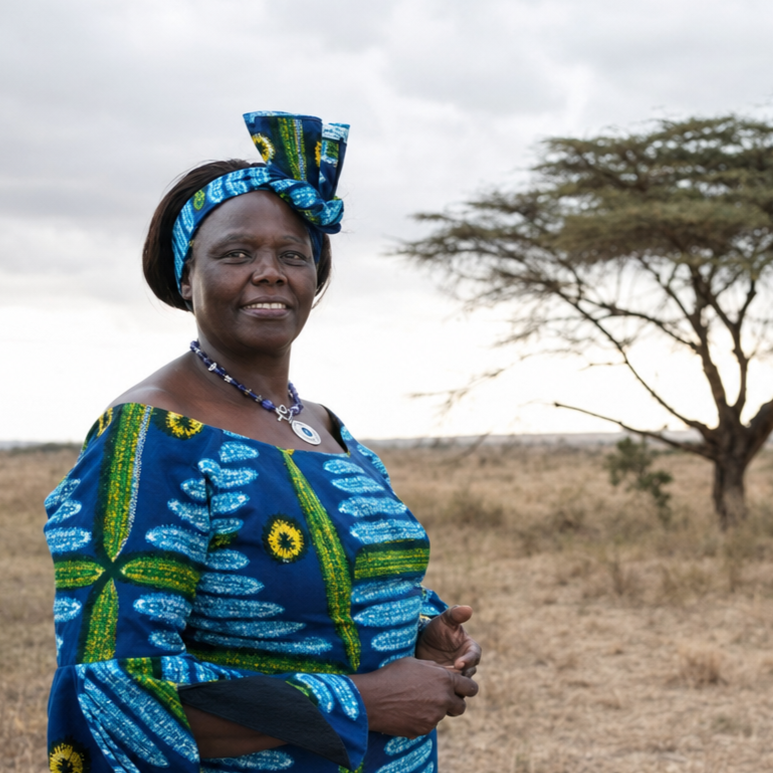
“When we plant trees, we plant the seeds of peace and hope.”
— Wangari Maathai
Environmental degradation and social inequality often intersect most directly in rural communities where women bear the responsibility for food, fuel, and water. In 1977, Wangari Maathai responded to these conditions by founding the Green Belt Movement, a women-led initiative that combined tree planting, community empowerment, and democratic participation in kenya. What began as reforestation grew into one of the most influential grassroots movements of its time, demonstrating that ecological restoration and women’s empowerment are mutually sustaining.
Wangari Maathai (1940–2011) was a Kenyan environmentalist, biologist, and political leader. She was the first woman in East and Central Africa to earn a doctorate, receiving a PhD in veterinary anatomy from the University of Nairobi. In 1977, she founded the Green Belt Movement, which began with the simple act of planting trees to restore degraded land and soon expanded into a national and international network for environmental justice, women’s rights, and democracy.
Maathai’s leadership extended beyond ecological work. She served as a Member of Parliament, Assistant Minister for Environment and Natural Resources, and global advocate for sustainability and human rights. In 2004, she became the first African woman to receive the Nobel Peace Prize for her contribution to sustainable development, democracy, and peace.
The philosophy of Wangari Maathai linked ecology, gender, and democracy.
Tree planting as empowerment: ecological restoration begins with simple, tangible acts
Women as leaders: ecological care is inseparable from women’s dignity and agency
Grassroots democracy: sustainable change emerges from community participation
Peace and ecology: environmental stability underlies social harmony and political stability
Interconnection: ecological, cultural, and political renewal reinforce one another
The Green Belt Movement has planted more than 50 million trees across Kenya, restored watersheds, and improved soil fertility. Equally important, it has trained tens of thousands of women in environmental stewardship, civic engagement, and income-generating activities. Maathai’s vision showed that ecological work could be a pathway for social transformation, giving communities tools to resist exploitation and advocate for their rights.
Her teaching demonstrates that ecology is political. By linking tree planting to democracy and peace, she reframed environmental care as a foundation for just societies. The empowerment of women, the restoration of landscapes, and the strengthening of democratic participation were not separate goals but facets of one integrated movement.
Wangari Maathai left a living legacy of trees, communities, and movements that continue to grow. She demonstrated that ecological care is an act of justice, and that the restoration of land is inseparable from the restoration of dignity. Her vision endures as a model of ecofeminism in practice, where the health of forests and the empowerment of women form one continuous path of renewal.
Resources & Further Reading
Maathai, Wangari. Unbowed: A Memoir. Alfred A. Knopf, 2006.
Maathai, Wangari. The Green Belt Movement: Sharing the Approach and the Experience. Lantern Books, 2003.
The Green Belt Movement
Nobel Peace Prize biography: nobelprize.org
